Monday, 14 November 2011

Monday, 10 October 2011
Summer Exhibitions
Over the summer I visited various exhibitions about photography. One of my favourite exhibitions was in the International Slavery Museum in Liverpool - 42 Women of Sierra Leone. This was a collection of portraits taken by british photojournalist Lee Karen Stow. She chose to take 42 images because that is the life expectancy for women in Sierra Leone. Her images capture the spirits and beauty of the women who come from all walks of life. One of my favourite photographs in the exhibition was of a female photographer working at a photo-shoot. With each image was some information about each person, the area they live in or the countries attitudes towards women. The information next to the image of the photographer explained that women are held at a much lesser standard than men, so much so that a female photographer is often likely not to get paid for her services.
Thursday, 28 July 2011
Rock of Joy Photoshoot
Last month a group of students from my photography class helped to set up and participate in a photo-shoot in which we raised money for The Rock Of Joy Trust. The charity helps to support a school in Uganda in its hopes to becoming completely self sufficient. We charged staff and friends for a fifteen minute photo-shoot, of which all proceeds went straight to the charity. I really enjoyed the day. It was good experience to photograph people other than those in my photography class. I also liked having the practise of using the studio equipment, directing people and being in a more professional environment. I learnt more about shooting in RAW, setting up lighting so that minimum post processing is needed and I learnt more about the different effects that you can get from faster lenses.
Take it to the streets exhibition


The exhibition was split between inside and out which I think gave a unique element to the exhibition because you could experience the photographs in a different environment. I think the outside element was also good because it would draw a lot of people into the exhibition who may be walking past, who might not normally visit art galleries. It helped that when we visited the exhibition it was a sunny day; in the pouring rain it may not have been as enjoyable. Because of the lack of space on the boards outside the layouts of the images was not as creative as the layouts of the images inside, but it all worked well together.


I liked the inside part of the exhibition more than outside. There was a wider range of styles of photography and I liked the different ways that the photographs were presented. As well as photographs, there were also videos which were part of the exhibition. The videos were interesting but as a whole I prefer still images and find them more interesting.
There were three photographers whose work I particularly liked, Bruno Quinquet, Raoul Gatepin and Giacomo Brunelli.
Giacomo Brunelli:

I liked these photographs because unlike many of the photographers Brunelli focused on animals rather than people. His portraits of the animals are very unusual, they are quite dark and mysterious and even though they are animals he still manages to capture intense emotion. I like the square crop to the images and I think that them having been shot in black and white makes them even more intense.
Raoul Gatepin:

I like the simplicity of these images, the emptiness of the places he has photographed. I like the composition of each of his photographs, I like the way he uses leading lines and bullseye composition. I also like the colour tones within the images and I think that because they seem almost desaturated slightly, it adds the the atmosphere of the images.
Bruno Quinquet:

I like how this photographer uses natural elements as the focus within his images, but still captures the street life surrounding them. I like the shallow depth of field that he uses and the way in which he uses natural forms to frame his shots. I think that the colours work really well within this set of images and helps add to the natural feeling that comes across when looking at the photographs.
Overall I really enjoyed the exhibition. There was a multitude of different types of work and styles which you might not have come across when simply doing your own research.
Wednesday, 18 May 2011
The next step
I decided that the best way for me to achieve my goals is to, after college, go into business for myself. University is not something that appeals to me much, and it is not necessary to have a degree to have a successful career as a wedding photographer. I think that it would probably be beneficial if I assisted a current wedding photographer but assisting jobs are not always easy to come by, and I think that it is not necessarily vital for my career. Instead of assisting I think that over the next year I will try and get some work experience with wedding photographers. Even if it is just shadowing them for a day at a wedding to see what a wedding is like from a photographers point of view. Through my course at college I will learn the basics that I need but I know that I will need to do a lot of research and work outside college in order for my skills and business knowledge to be good enough to be successful.
Tuesday, 17 May 2011
Deciding on a career
Out of the four areas of photography that I looked at in more detail, the area that interests me most is Wedding photography. Weddings are something that I have always been interested in, so I think that it is something I could be good at. It also means that I do not have to focus on just one area of photography i.e. landscapes or architectural or portrait; wedding photography incorporates all areas of photography and I think that this would be more interesting than just focusing on one area, and it means that my skills in all areas would be constantly developed and improved.
Thursday, 5 May 2011
Portfolio Advice
Staffordshire University included within their leaflets, a guide to portfolio interviews. I think that this is quite useful because even though I do not wish to go to University, I will be required to attend portfolio interviews for jobs.
The leaflet explains that the portfolio is a way of showing your aptitude and commitment to the chosen subject, and should show why you should be chosen with the highly competitive environment. The work included needs to be selective and you will need to be able to explain why you have chosen each piece of work. The images do not have to necessarily be ones that you like, but ones that are able to communicate something in an effective or interesting way.
As all university courses and jobs are different, there is not a set style of portfolio. You should make enquiries to the course leader or employer to see what you are going to be interviewed at, to make sure that what you include in your portfolio is relevant.
An ideal size for a portfolio is either A3 or A2, with between fifteen and twenty sleeves. The first sleeve should provide your name and a contents list of what work is included, when it was produced and why. For university interviews you will also be required to provide an example of written work e.g. an essay relating to photography/art. Portfolios should also be supported by sample sketchbooks (2 max.).
UCAS Fair Visit, Nov 2010
We visited a UCAS fair in Manchester to see and talk to universities from throughout the country. The fair housed a wide range of universities and focused on creative courses. There was lots of information available in a range of sources – prospectus’s, leaflets, examples of students work, tutors and current students. The tutors and students were very helpful and, where they could answered any questions we had. I think that it would be a valuable experience for someone who is starting to look at choices for university or possible further education, however, as I have already been through the UCAS process and to many UCAS fairs, I did not find the day very beneficial. Some of the universities did include advice about building portfolios within their information leaflets, which I think will be helpful when building my own portfolio.
For or Against Uni
For:
· Social life and lifestyle
· More qualifications
· Contacts
· Experience
· People with degrees earn on average more than those who don't have degrees
· Peer guides and advice and feedback from other students
Against:
· Moving away
· Fees
· Not necessarily going to help get a job
Going to university can be a unique experience and as you gain higher qualifications can potentially give you better job prospects. I however do not want to go to university. When I applied to university during my A levels, one of the main reasons I wanted to go was so that I could move away. It was however never the definitive way that I wanted to enter a career in photography, I was always looking for another route which may appeal to me more.
The academic side of university appealed to me but the social side of it was never something I was interested in. After I didn't get on to any courses I looked more into other routes such as assisting jobs or an apprenticeship. These however required you to have experience and at least a diploma in Photography. So that I could go down that route at a later date, I came to college to complete a diploma. Working toward the diploma also meant that I could stay local, as moving away is no longer an option that appeals to me.
Although on average people with degrees earn more than those who don't have one, there are so many people with degrees these days that often people are unable to gain a job in their chosen profession. I know lots of people who have come out of university with a degree but are now either unemployed or in a job unrelated to their degree and am finding that no related jobs are materializing. I would rather get a practical job within the industry and work my way up from an assistant or trainee photographer and gain experience on the job and then continue on to set up my own business.
Wednesday, 27 April 2011
Professional visit - Ian Han, Wedding Photographer
Ian Han is a Cheshire based wedding and portrait photographer. He came in to show us some of his work and talk about his approach to this style of photography.
He started by talking about the different elements of wedding photography. He explained that it is a versatile aspect of photography as it incorporates so much. It is a mixture of documentary, still life, portrait, architectural. Fashion and food photography; and sometimes can also include studio photography.
Each wedding photographer has a different approach to their work. Han likes to meet with the couple to discuss their requirements and wishes for the big day as well as having a photo-shoot with the couple before the wedding. This is so that the couple can get to know Han and will feel more relaxed around him on their wedding day. It is also so Han can get to know the couple and see how they act in front of the camera. In these meetings he explains that it is useful to gain a schedule for the day and to make sure that adequate time has been set aside to take photographs. It is also useful for the couple to make a list of who they wish to be included in formal photographs and for them to allocate someone to organize the groups ready for the photographs. This will help ensure that the day runs smoothly and that everyone who is wanted is included in the images.
As the photographer it is your job to document the wedding and everything that is going on during the day, including capturing moments which can not be planned for. There are key shots that most wedding photographers will aim to get, there may also be specific shots that the couple may request.
On the day the focus is usually on the bride, she is most likely the one who has planned and organized the wedding. The day will usually start in the brides house, documenting her and bridesmaids getting ready. These are part of the establishing shots and should include key elements such as details on the brides and bridesmaids dresses, shoes, flowers etc. the photographer will then usually make their way to the venue before the bride and get there in time to document the groom and groomsmen arriving, then shortly after the brides arrival. The photographer should also take shots of the venue. Next is the ceremony where shots of the bride waling up the isle etc. are usually expected. Key shots at this point also include the signing of the book, and the couples first kiss as a married couple. When taking these shots it can be important to ask whoever is conducting the ceremony to ask guests to wait until after you have taken the shots you require, before they take their own as your own images may end up overexposed due to extra flashes.
At the next venue it is also important to take establishing shots of the building/room. You also need to take details shots of seal and table decorations, flowers, place names etc. as these as well will have been carefully planned. If possible it is a good idea to get to the venue a few days before the wedding so that you can see the space and the type of lighting which is there. You will then be able to adjust your ISO and white balance accordingly.
When taking formal shots you should be quick and make it as enjoyable as possible, guests as well as the newly weds will not want to stand around for long periods of time. When taking group shots you generally need to focus in the middle of the group and have an aperture of around f8. You need to also be prepared for outside shots and be able to quickly and effectively change camera settings to suit the lighting situation.
There will then be key shots like speeches and the first dance to take. When photographing speeches it is often useful to move around the room and anticipate where the speech is headed so that you can capture the reactions of the guests. It will then depend on each couples requirements as to how long you are at the reception for.
The next part of the wedding is the post production, software like photoshop and lightroom are good for batch processing. You will also need a way to present and sell images to your client. Han often uses photobooks from various companies which give a professional finish. He brought some of the books which he has produced with him to show how he presents the finished product to the client.
Over the years in which Han has been photographing weddings he has increased his collection of equipment. He suggested that the basic kit needed to shoot a wedding would be two SLR cameras, an off camera flash and a tripod. Plenty of memory cards and batteries are also needed. A range of lenses is also useful at a wedding because of the range of photographs you will be taking, a standard lens could probably be used for the majority of shots, a wider lens could be useful for wider shots, macro for details etc. He also explained that, especially when shooting weddings, the professional ranges of cameras can be very useful. They often have quieter shutters and so are less disturbing to the service and have screens displaying settings on the top of the camera so changing settings can be quicker.
Forensic Photography
What the job entails:
Forensic photographers are required to produce visual records of the scene where a crime or accident has taken place. They need to also produce visual records of evidence including wide shots of the scene as well as details such as fingerprints, tire marks, blood splatters etc. They also need to take detailed photographs of injuries sustained during an accident and dead bodies.
Typical career routes:
Most photographers within this field start as a Crime scene investigator before specializing in photography or forensic imaging. It is not necessary for them to have formal training within photography but a previous qualification often enhances their chance of selection.
Training and qualifications:
Forensic Photographers usually receive general training in crime scene photography once they have already been selected as a Crime Scene Investigator or a Scene of Crime Officer. The qualifications necessary to gain work as a CSI or SOCO are usually at least good passes at GCSE or Standard Grade, including English and either science (Biology/Chemistry) or maths, and at least one A level or Higher in a science subject. A typical route is to complete a course in photography and to apply for job within the police force or specialist forensic agencies. There are also specialist forensic imaging courses such a degrees and specialised training in Fingerprints, footwear and lighting.
Essential skills and knowledge:
Forensic photographers need to have a good knowledge of photographic techniques and processes, and be able to pay attention to detail. They also need a good grounding in police methods and must also have a good knowledge of human anatomy.
Employment:
Most forensic photographers are employed directly by the police or specialist forensic agencies. They work pre-defined shifts and a salaried post. Vacancies for Forensic Photographers are advertised in the national press and in specialist journals such as New Scientist, Police Review and the British Journal of Photography.
Medical Photography
What the job entails:
Most medical photographers will work within small medical illustration departments in either hospitals or medical schools. Their job is to record the work of healthcare professionals as well as record patients injuries and diseases to be used either to help with treatments or for education. They will photograph patients on the wards, the operating table and bodies in the post mortem room.
Career Routes:
Most medical photographers will have some sort of science related degree level qualification, a photographic education as well as a specific medical photography qualification. Once in the field the photographers then have the opportunity to specialise in different aspects of medical photography.
Training, skills and qualifications:
They need a thorough grasp of photographic techniques and of which equipment would be appropriate for various situations within the medical setting. They also need a basic knowledge of human anatomy and the origins of disease. They need an interest and knowledge of scientific terminology in order to communicate with medical staff. Medical photographers are required to have a HND level course in photography followed by a training post at a teaching hospital. They also need to complete a Post Experience Certificate in Medical Illustration or a Qualifying exam in Medical Photography. Or to complete a full time HND course in Medical Illustration.
Equipment:
They require a digital SLR or a 35mm equivalent. They also need more complex equipment for micro- and macrography, time-lapse cinematography, thermal imaging, endoscopy and photography outside the visible spectrum.
Typical salary:
There are different pay bands set for medical photographers within the NHS. A trainee can earn between £12,800 - £15,500; a more experienced photographer can earn £15,500 - £24,000; and a medical photographer in a managerial position can earn £24,000 - £35,000.
Job vacancies:
Jobs are advertised in numerous medical publications, the British journal of photography and NHS websites.
Examples of medical photography:


Examples of medical photography:
Wedding Photography
What the job entails:
Wedding photography is a mixture of many different aspects of photography. It combines documentary, still life, portrait, architectural, fashion, food and sometimes studio photography. It involves recording the happenings of the day photographing memorable moments as well as capturing key photographs such as:
· Details - the dress, shoes, cake, flowers, car etc.
· The venue
· The bride getting ready
· Group shots
· The bride and groom - the signing of the book, a kiss etc.
The main focus of a wedding is usually the bride so the majority of the photographs will be documenting the bride throughout the day.
Career routes, training, skills and qualifications:
Most wedding photographers will work freelance. Many will have diplomas or degrees in photography, they may have also completed shorter courses specifically aimed at wedding photography. After gaining their qualifications, they may be an assistant to a more established photographer before setting up their own business in wedding photography. As well as having photographic knowledge, a wedding photographer needs to be able to communicate will people in order to gain the shots they want and in order to be able to organize group shots.
Equipment:
· At least two cameras - usually digital SLRs (cameras from the professional ranges of manufacturers will have quieter shutters and therefore be more appropriate in a wedding setting)
· Spare batteries
· Multiple memory cards
· Flash
· Tripod
Typical salary:
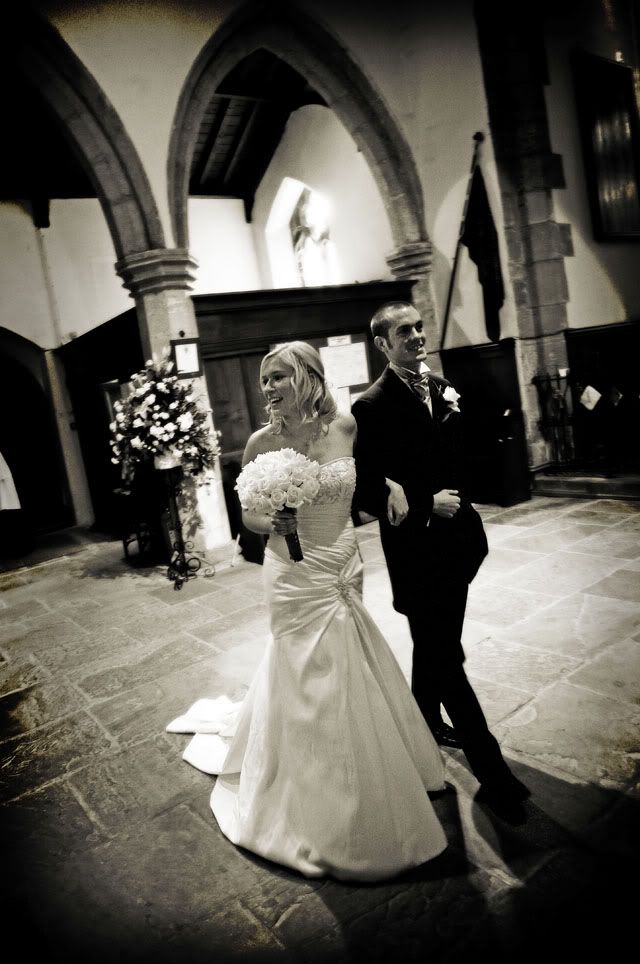
It is difficult to find statistics about the salaries of wedding photographers. As many of them are freelance they are able to choose their prices themselves. They will take into account how much money they need per month/year to live on, how much their camera insurance is etc. and come up with their own price. Prices also depend on how clients wish their photographs to be displayed. As the prices vary so much there is usually a photographer available for every clients price range.Examples of wedding photography:


Fashion Photography
What the job entails:
Fashion photographers work in both studios and on locations. It is their job to photograph the garments and incorporated ideas of clients and influences from the seasons. They have to be able to understand the client's brand image and produce unique and interesting shots to fulfil their brief. High fashion photographers and magazine photographers often work within their own studios or in studios supplied by clients. They must be innovative and creative and be constantly refreshing their style to keep up to date. Mail-order catalogue photographers usually work with an array of models in various situations photographing a single range of clothing over a few days or weeks producing enough photographs to fill a catalogue. These photographers have the security of regular employment but rarely earn as much as high fashion and magazine photographers.
Career routes:
Many fashion photographers will start out in the business as an assistant to a more established photographer and will learn on the job. This provides the photographer with experience and contacts such as various art directors, clients and models.
Training, skills and qualifications:
Various colleges and universities offer courses in photography and more specifically fashion photography. These give a wide knowledge of the fashion industry however it would be more valuable and helpful to start as an assistant to another photographer. You need to have a wide interest in the whole fashion industry, not just photography, and be creative and innovative with your techniques. As photographers will be meeting clients and working with models and art directors they need to have good interpersonal skills, and be able to source accessories and props.
Typical salaries:
Most fashion photographer’s work on a freelance basis and starting salaries are often low. A day shooting for a magazine may start at around £150 rising to around £600 for someone with more experience. In other areas of fashion photography the more experience photography can command around £3,000 for a days work.
Examples of fashion photography:
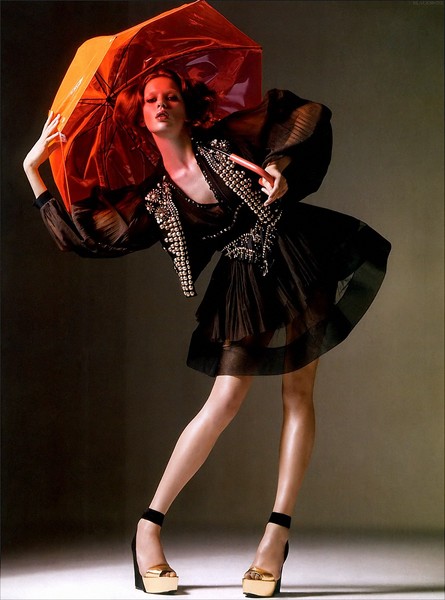


Examples of fashion photography:

Careers Within The Photography Industry
Advertising
Fashion
Wildlife
Forensics
Wedding
Medical
Sports
Photojournalism
Paparazzi
Event
Portraiture
Editorial
Architectural
Military
Documentary
Marine
Music
Travel
Fine Art
Food
The areas of photography that I am probably most interested in would be fashion, wedding, medical and forensic.
Fashion
Wildlife
Forensics
Wedding
Medical
Sports
Photojournalism
Paparazzi
Event
Portraiture
Editorial
Architectural
Military
Documentary
Marine
Music
Travel
Fine Art
Food
The areas of photography that I am probably most interested in would be fashion, wedding, medical and forensic.
Subscribe to:
Comments (Atom)